The job description is a lossy summary of who a company needs, and the best AI thinking of the last year points to learning from outcomes instead of hand-written rules. Here is what a recent conversation on AI-driven recruiting, plus the work of Rich Sutton and Yann LeCun, suggests for how talent should be matched.
In a recent episode of the Derby Mill series from Intrepid Growth Partners, one of the panelists made a point every recruiter will recognize. A job description does two jobs: it forces a group of stakeholders to agree, and it markets the role. In neither case, the panelist said, is it the truth.
The reason is simple. To get five or ten people aligned, a hiring manager has to write down one version of "great." In practice there are often three or four different profiles they would happily hire. Economist Sendhil Mullainathan added the deeper problem: people struggle to describe a job or a person in words, and match quality tends to show itself only once someone is doing the work.
The practical answer described on the panel was to treat the profile as a living document the AI keeps updating as real applicants arrive, rather than a fixed posting. The same panelist also reframed what precision means. If a thousand people could do a role well and a company hires a hundred, the goal is not to find the one perfect person. It is to cut the number of wrong hires from 10 to 20 down to 3 to 5.
That framing matters for anyone who matches talent to work. The brief is the starting hypothesis, and the evidence that follows should be allowed to revise it.
Rich Sutton, a 2024 Turing Award recipient and a pioneer of reinforcement learning, appeared on the same panel. His 2019 essay "The Bitter Lesson" reviews seventy years of AI research and finds the same pattern again and again. Researchers build their own understanding of a domain into their systems, which helps in the short run. Then methods that simply use far more computation, through search and learning, overtake them. He walks through four cases: chess (the 1997 defeat of Kasparov by deep search), Go, speech recognition and computer vision. His conclusion is that search and learning are the two approaches that keep scaling as computing power grows. The recruiting-software founders on the panel said they apply that mindset by avoiding hardcoded hiring rules and concentrating on collecting the best context: intake calls, interviews and debriefs.
The essay's second point is the one that bears most on talent matching. Sutton argues that the world and the human mind are too complex to describe with a few simple built-in ideas, so we should build methods that can discover that complexity rather than systems that contain what we have already discovered. In his words, we want agents that can discover like we can. A job description or a fixed skills taxonomy is a stored discovery of exactly that kind: it records what someone believed mattered at one moment. To be clear, the essay is about AI research methods, not recruiting. Applying it to hiring is an extrapolation, one that the recruiting founders on the panel also described making.
Sutton's more recent work with David Silver, "The Era of Experience", goes a step further. The authors argue that knowledge drawn from human data is nearing its limit in areas such as mathematics, coding and science, and that agents should improve mainly by acting and learning from the results.
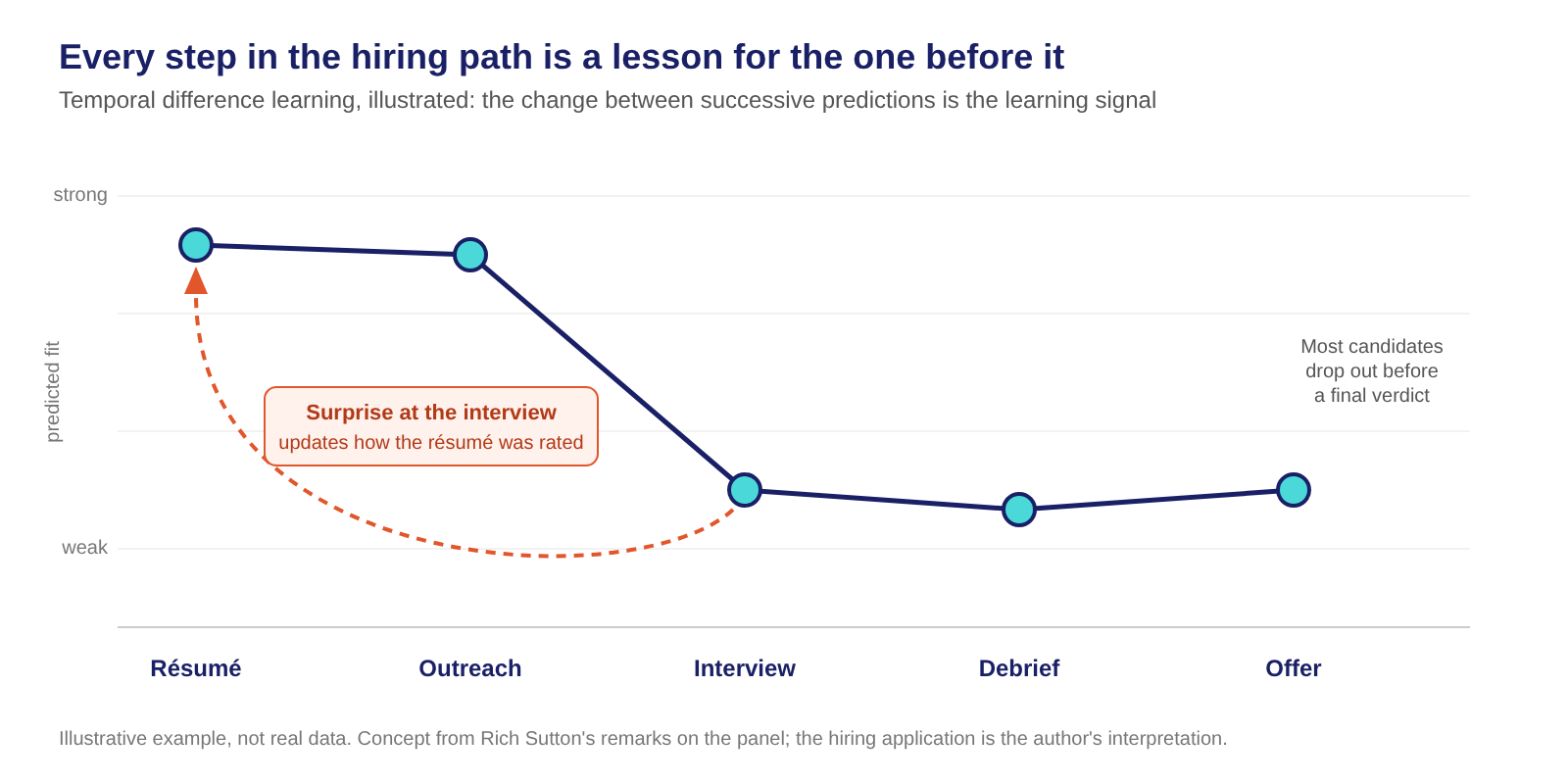
Hiring is a natural fit. On the panel, Sutton pointed out that a candidate moves through a sequence of judgments: resume, outreach, interview, debrief, offer. Most never reach a final verdict, because they drop out along the way. His suggestion was temporal difference learning, which uses the change between one prediction and the next as the learning signal, so the system improves without waiting for a final outcome. A candidate rated well on paper and poorly after an interview is a lesson about the first rating.
For talent matching, the lesson is that every screening step, interview note and placement result is training signal. Systems that capture those signals and learn from them should outperform static keyword rules.
Yann LeCun, a Turing Award laureate who spent twelve years as Meta's chief AI scientist, left to launch AMI Labs in Paris, which opened in March 2026 with a $1.03 billion seed round. His position is that large language models are very good at language, code and math but are not a path to human-like intelligence.
His alternative is the world model. In his framework, a world model learns an internal picture of how an environment behaves so it can predict the consequences of actions and plan accordingly. His JEPA architecture does this by predicting in an abstract representation space rather than generating every pixel or word.
The analogy to hiring is ours, not his, but it is useful. A resume and a job post are text. What a placement depends on is the situation around them: the team, the manager, the pace of the work, how well each person's strengths complement the others. A matching system that only compares text to text is reading the description of the world rather than modelling it. The harder and more valuable question is what is likely to happen if this person joins this team to do this work.
It is worth noting that LeCun's view is contested. Coverage of his bet is candid that nobody yet knows who is right. Our point is not to pick a side in that debate, only to take its useful question seriously.
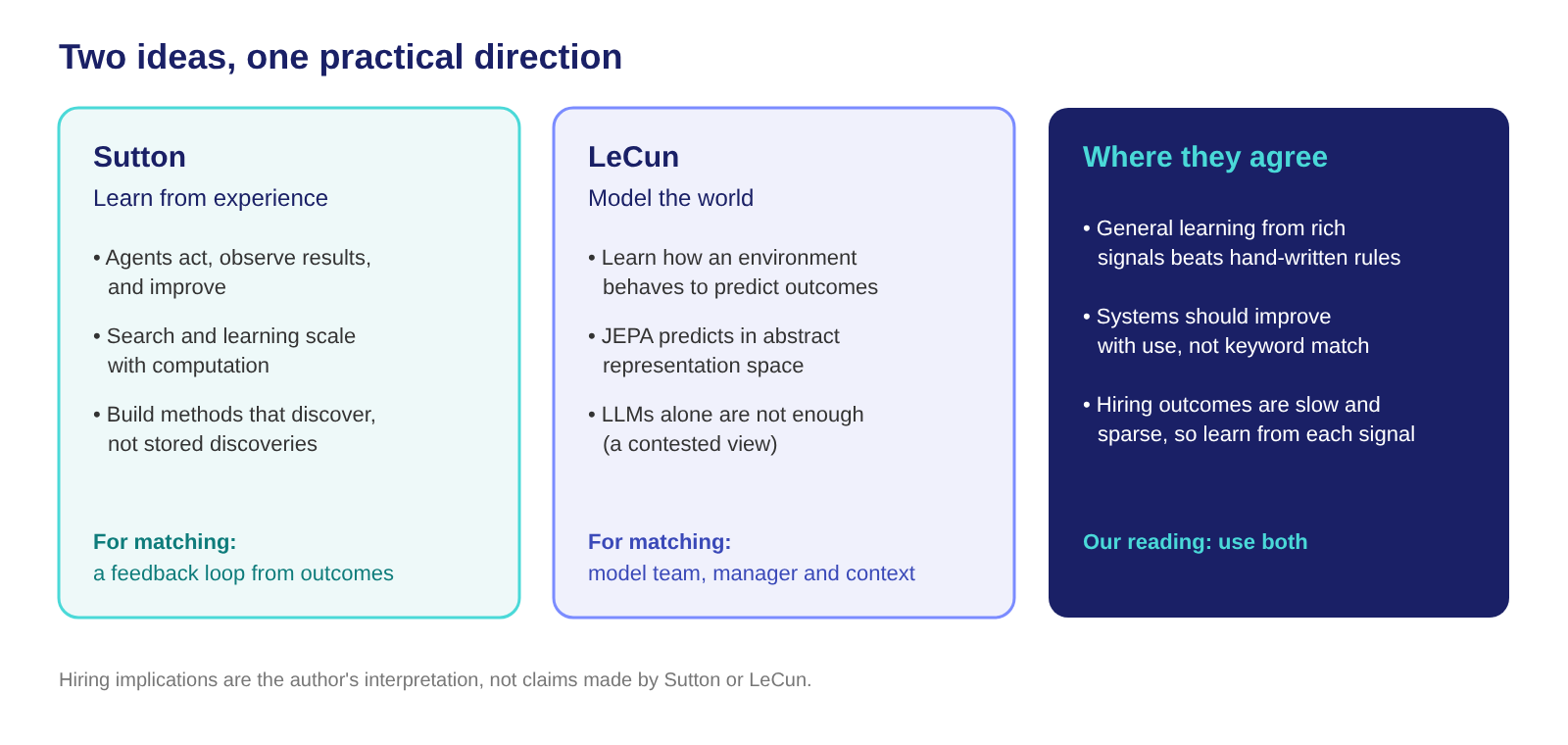
The two researchers disagree on method. Sutton puts experience at the centre: agents act, observe results and improve, with reinforcement learning as the engine. LeCun, in a summary of a recent Harvard talk, is described as calling reinforcement learning inefficient and preferring to plan through a learned world model.
They agree on something more practical for recruiting: general learning from rich signals tends to beat rules written by hand. Both views also point away from keyword matching toward systems that improve with use.
Hiring adds a constraint that makes the debate relevant. Outcomes are slow and sparse. A placement takes months to judge, and no company runs millions of them. That favours approaches that learn a lot from each signal, which is the appeal of Sutton's learning from successive guesses and of LeCun's models that predict what will happen. Our reading is that a practical matching system needs both: a feedback loop from real outcomes, and a structured understanding of how roles, skills and teams relate.
Sendhil Mullainathan's best-known early work measured hiring bias directly. In "Are Emily and Greg More Employable Than Lakisha and Jamal?", published in the American Economic Review in 2004, Marianne Bertrand and Mullainathan answered real help-wanted ads in Boston and Chicago newspapers with fictitious résumés. They randomly assigned names that sounded White or African-American.
The résumés with White-sounding names received about 50% more callbacks for interviews. A stronger résumé raised callbacks more for the White-sounding names than for the African-American-sounding ones, and the gap appeared across occupations, industries and employer sizes. The authors found little evidence that employers were inferring social class from the names.
The design is what makes the result useful to anyone building hiring tools: identical qualifications, one randomized difference, a measurable outcome. Two implications follow, and both are our reading rather than the paper's. First, a system trained on past callbacks and hires can inherit patterns like these, because those records reflect human decisions. Second, the same audit logic applies to software. Compare outcomes for otherwise equivalent candidates and look at the gaps. The paper studied human employers, not AI, and the panel's point that more context and more inspectable decisions can help is a reason to test, not a guarantee of fairness.
The panel raised three ideas that go past matching one person to one job.
Teams, not onesies. Ajay Agrawal of Intrepid suggested that companies hire people one at a time largely because coordinating groups has been costly. If AI lowers that cost, hiring pairs and clusters who work well together could become normal. Sendhil Mullainathan noted that acquirers already buy startups for their teams, and another panelist described an investor valuing two acquired employees at more than two because of their shared history.
Information that is hard to write down. Mullainathan argued that much of what drives a good match, such as real motivation or how someone works with others, never makes it onto paper. He suggested the next gains may come from tools that help people say what they cannot easily say, and from trusted ways to share honest references.
Humans stay in the loop. The panelists were clear that AI cuts the slow, repetitive work, such as drafting briefs and sourcing, while people still make the judgments that depend on chemistry and trust. One panelist added that bias often comes from lacking data and time, so more context in front of decision makers can make decisions easier to inspect, though it is not the only fix.
Speaker attributions from the episode were inferred from an unlabeled transcript. The comparison to hiring is the author's own interpretation, not a claim made by Sutton or LeCun.