
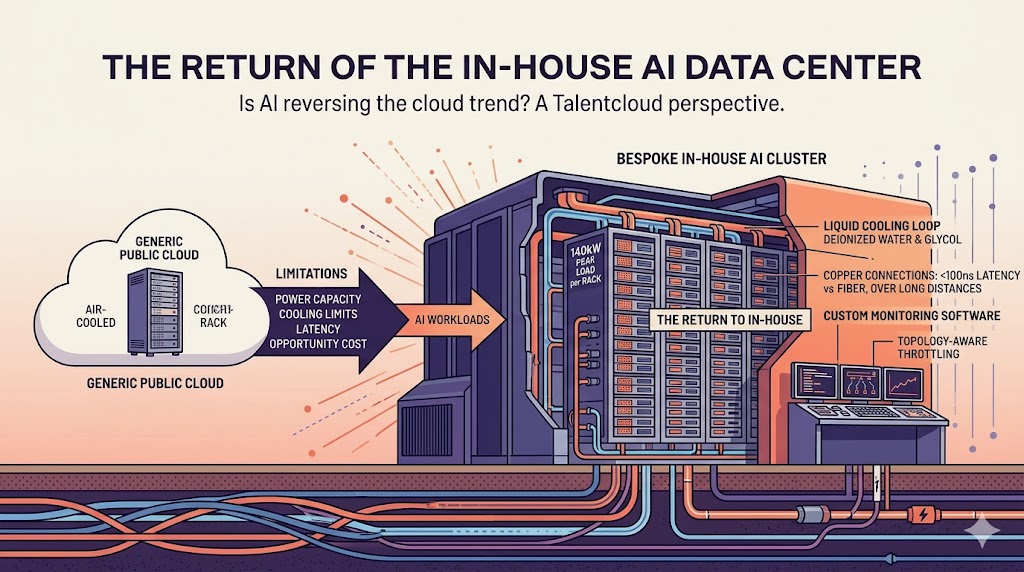
At TalentCloud Technologies (www.talentcloudtech.com), we closely monitor the infrastructure shifts shaping the future of technology. For the past decade, the tech industry has leaned heavily into the public cloud and most corporations are still working on cloud migrations. However, the extreme physical, economic, and performance demands of modern AI training workloads are triggering a fascinating question: Are we about to see a massive return to in-house, proprietary data centers?
A recent behind-the-scenes video tour of Jane Street’s (one of Wall-streets' prominent firm) live AI training data center in Texas provides compelling evidence that for high-stakes AI, owning and managing your own physical infrastructure is becoming a massive competitive advantage.
Here is why the unique demands of the AI era—as highlighted by Jane Street’s technology and engineering leaders, Yaron Minsky and Daniela Corvo—might make the case for building in-house.
Generic cloud environments are built for multi-tenancy and standardized workloads. But AI clusters demand unprecedented physical density that are just not available with outsoruced cloud providers.
When your hardware demands this level of bespoke thermodynamic and mechanical engineering, off-the-shelf cloud data centers may no longer fit the bill. As you redefine your competitive business processes for AI weaponization, you will end up training for those data sets to move faster with more precisely against your competitors and market.
In the video, Minsky emphasizes that the true price of an AI training run is dominated by opportunity cost. Within high-performing businesses, compute is inelastic, and internal teams are constantly competing for server time because the proprietary models they generate are incredibly valuable to the core business.
To maximize every single rack, Jane Street manages its infrastructure right on the absolute edge of its power limits. They achieved this by building their own proprietary, topology-aware monitoring software that connects directly to breaker panels. If the system approaches a dangerous current threshold, the in-house software automatically shuts down specific nodes in a controlled sequence to avoid tripping a breaker and ruining a training run. This level of granular, revenue-critical control is difficult to safely replicate on a shared public infrastructure.
For companies running cutting-edge models, physics dictates infrastructure layout. Jane Street’s setup features over 8,000 kilometers of fiber optic cable, yet the fastest connections inside their equipment cages rely entirely on copper.
The reasoning is pure physics: electrons move faster through copper than light travels through glass fiber over short distances. By tightly packing and custom-wiring their own in-house cluster, they are able to optimize for a staggering packet turnaround time of under 100 nanoseconds. When your business relies on fractions of a nanosecond, every millimeter of physical placement matters—making an in-house, tightly controlled layout essential.
Historically, companies moved away from in-house clusters because of early logistical headaches. (Minsky even joked about Jane Street's early days when a 6-box desktop cluster called "The Hive" was accidentally unplugged mid-day by an office vacuum cleaner!).
But today’s enterprise AI reality is completely different. The specialized requirements of liquid cooling, custom power-throttling software, and extreme latency optimization mean that the pendulum is swinging back. For organizations where AI models dictate market dominance, managing your own physical data center provides the ultimate control over performance, cost, and execution speed.
Are you noticing a shift back to on-premises or proprietary infrastructure for heavy AI workloads in your industry? Let’s discuss in the comments.
📺 Watch the full technical tour that inspired this breakdown: Dwarkesh Goes Inside Jane Street's Latest AI Data Center
#AIDataCenters #HardwareEngineering #DeepTech #Infrastructure #CloudComputing TalentCloud Technologies Inc