The argument in three lines
In 2002, Magnus Sverke, Johnny Hellgren and Katharina Näswall at Stockholm University published No Security: A Meta-Analysis and Review of Job Insecurity and Its Consequences in the Journal of Occupational Health Psychology. They pooled 72 published studies — 86 independent samples, 38,531 working people across countries, occupations and industries — to answer a simple question: what does the fear of losing your job actually do to you, and to the organisation you work for?
The answer was consistent. Job insecurity was significantly related to almost every outcome they measured:
Two findings deserve more attention than they usually get. First, the authors note that anticipating a stressful event can be as damaging as the event itself. When you lose a job, you can grieve and plan. When you merely might lose it, you are stuck with uncertainty and none of your usual coping strategies work. Second, the people who act on that uncertainty first tend to be the most employable — the ones with the most options. Insecurity quietly selects your best people out of the organisation.
Job insecurity is not the same as job loss. It is an everyday experience of prolonged uncertainty — and that uncertainty, not the event, is what does the damage.
Interestingly, the meta-analysis did not find a significant overall link between insecurity and self-reported performance. People kept delivering. What they withdrew was trust, commitment and loyalty — the things that never show up on a timesheet until they are gone.
That research described the early stages of a shift the authors saw coming: downsizing, restructuring and “more flexible” work making insecurity a permanent condition rather than an occasional shock. Current survey data shows how workers have responded. They have stopped expecting one employer to provide security, and started optimising for the things they can control.
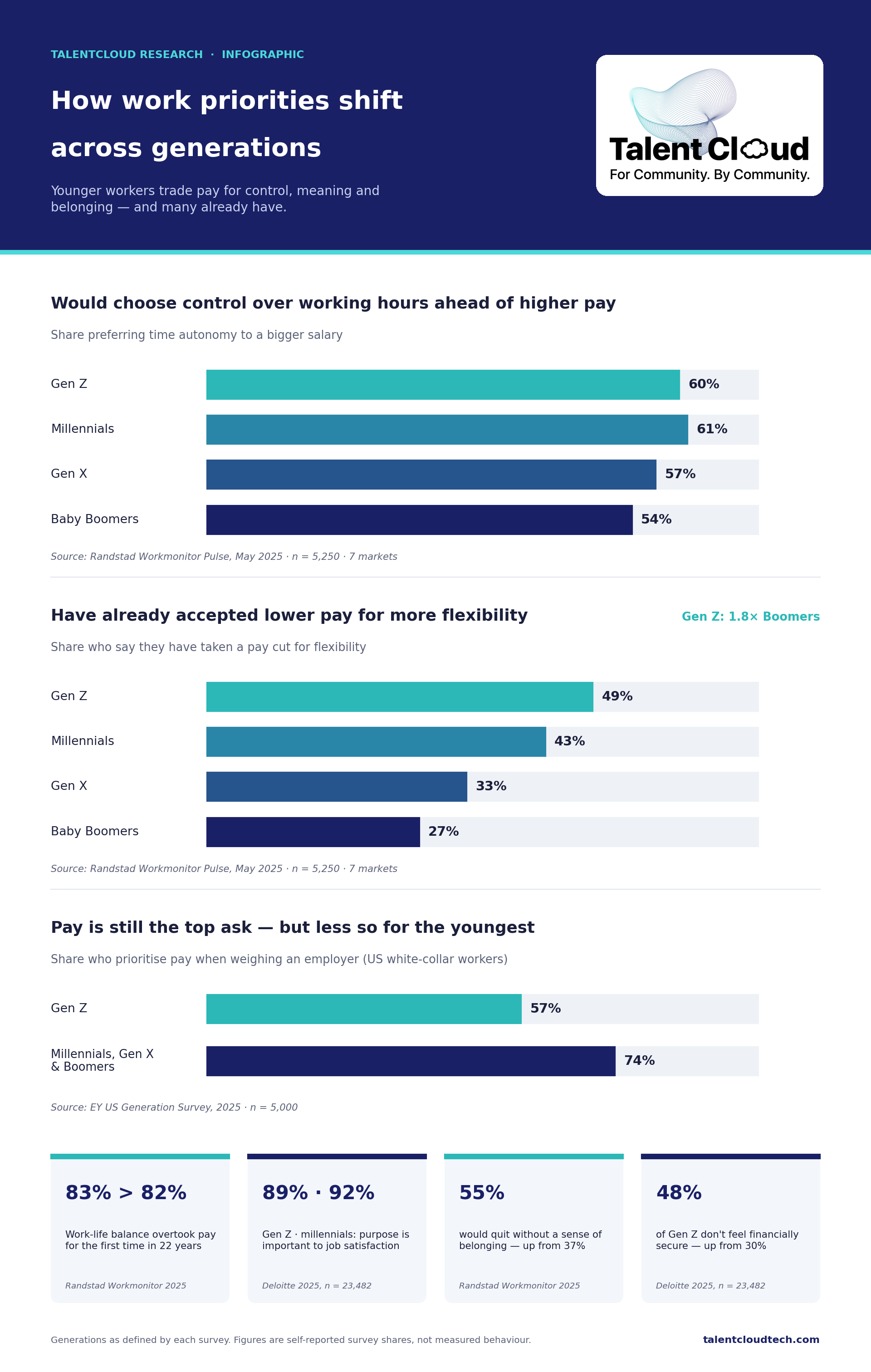
How work priorities shift across generations. Sources: Randstad Workmonitor Pulse, May 2025 (n = 5,250, 7 markets); Randstad Workmonitor 2025 (n = 26,778, 35 markets); EY US Generation Survey 2025 (n = 5,000); Deloitte Gen Z and Millennial Survey 2025 (n = 23,482, 44 countries).
Four patterns stand out.
In Randstad’s 2025 pulse survey, a majority of every generation said they would choose control over their working hours ahead of higher pay: 60% of Gen Z, 61% of millennials, 57% of Gen X and 54% of baby boomers. And in its main 2025 Workmonitor, work-life balance (83%) overtook pay (82%) as the top priority for the first time in the survey’s 22-year history.
Preference is one thing; sacrifice is another. Nearly half of Gen Z (49%) say they have already accepted lower pay for more flexibility, compared with 43% of millennials, 33% of Gen X and 27% of boomers. Gen Z is roughly 1.8 times as likely as boomers to have made that trade. EY’s 2025 US survey tells the same story from the other side: 57% of Gen Z prioritise pay when weighing an employer, against 74% of the older generations.
Deloitte’s 2025 survey found 89% of Gen Z and 92% of millennials say a sense of purpose is important to their job satisfaction. That is not idealism crowding out pragmatism: the same survey found 48% of Gen Z and 46% of millennials do not feel financially secure, sharply up on the year before. People want money and meaning, because when security is scarce, meaning is what makes the uncertainty bearable.
The Stockholm researchers found insecurity erodes trust and commitment. Randstad’s 2025 data shows the flip side: 55% of workers would quit a job where they do not feel a sense of belonging, up from 37% a year earlier, and 83% say they want a sense of community at work. When the contract cannot promise permanence, people look for it in the relationships around the work.
Put the 2002 meta-analysis next to the 2025 surveys and the conclusion is hard to avoid. The source of security at work has shifted. It used to be the employer. Increasingly it is your skills, your reputation, and the community of people who know what you can do.
That is a problem for traditional hiring, which still treats every engagement as a one-off transaction: a CV goes in, a role comes out, and the relationship ends when the contract does. It is also a problem for organisations, because the research is clear that insecure, disconnected people withdraw trust and commitment long before they hand in their notice.
TalentCloud’s model starts from that shift. Our tagline is For Community. By Community. — and it is meant literally.
For organisations, the same model answers the other half of the research. You get verified talent matched in as little as 48 hours, working inside a community that has a reason to care about the outcome — not a pool of anonymous contractors with one eye on the exit.
No one can promise a job for life anymore, and the research says the uncertainty itself does real harm. But the data also shows what people are reaching for instead: control, meaning and belonging. Those are things a community can provide even when a single employer cannot.
Security used to come with the job. Now it comes with the people around you.
Whether you are a professional looking for meaningful work or an organisation looking for people who will stay invested, join the TalentCloud community or talk to our team.
Sverke, M., Hellgren, J. and Näswall, K. (2002). “No Security: A Meta-Analysis and Review of Job Insecurity and Its Consequences.” Journal of Occupational Health Psychology, 7(3), 242–264. Correlations quoted are the paper’s attenuation-corrected population estimates; studies covered were published 1980–1999. Randstad Workmonitor 2025 (n = 26,778, 35 markets, fielded October–November 2024) and Randstad Workmonitor Pulse (n = 5,250, 7 markets, March–April 2025). EY US Generation Survey 2025 (n = 5,000 US white-collar workers, June–July 2025). Deloitte Global Gen Z and Millennial Survey 2025 (n = 23,482, 44 countries). Survey figures are self-reported; generations are as defined by each survey. Correlation does not establish causation.